Fueling the future, One drop at a time.
- robertkubinski
- Mar 4, 2025
- 4 min read
Updated: Apr 16, 2025
Ever wonder why you temps is running a little hot? Or brakes feeling a little sponge? Knowing what to look for or what to look at might help you before driving to work or on long trips. Checking and topping off all of your fluids is important for longevity, performance, and safety. In the long run, it may save you money on costly repairs down the road. Each fluid plays an important role in the performance in your vehicle.
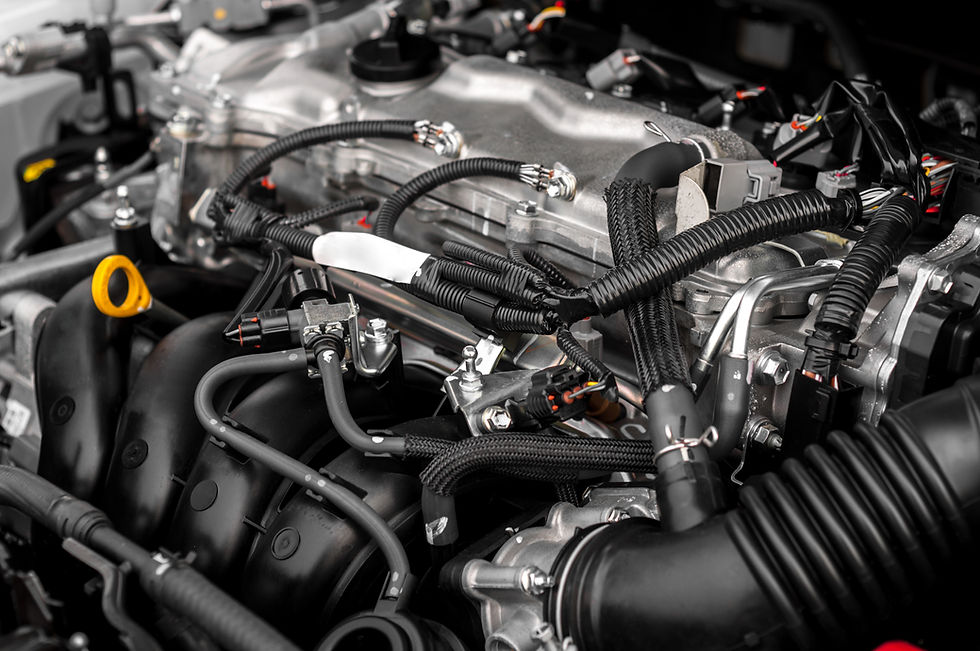
Engine oil.
When checking your oil.
Park your vehicle on level ground.
Ideally, check the oil when the engine is cold, or after it has been off for at least a few minutes, to allow the oil to settle in the oil pan. However, some car manufactures suggest checking the oil when the engine is warm, so always refer to your vehicles owners manual.
Open the hood of your car.
The oil dipstick is typically a long, thin metal rod with a brightly colored handle (often yellow or orange).
Pull the dipstick out completely.
Wipe it clean with a rag or paper towel.
Reinsert the dipstick fully into its tube.
Pull it out again and observe the oil level.
The dipstick will have markings indicating the minimum and maximum oil levels. The oil level should be between these marks.
When adding oil.
If the oil level is below the minimum mark on the dipstick, you need to add oil.
It's best to add oil a little at a time and recheck the level, to avoid overfilling letting it sit for a few mins to drain into the oil pan.
Consult your vehicle's owner's manual for the recommended oil type and viscosity.
Using the correct oil is crucial for proper engine lubrication and performance.

Coolant
When checking your coolant.
Most modern vehicles have a translucent plastic coolant reservoir. This allows you to visually check the coolant level without removing any caps.
Consult your vehicle's owner's manual to pinpoint the location of the coolant reservoir.
Look for "MIN" and "MAX" lines on the side of the reservoir.
The coolant level should be between these lines.
Check the level when the engine is cool.
While checking the level, also observe the coolant's color. Healthy coolant typically has a bright, clear color (green, orange, pink, or blue, depending on the type).
Muddy or rusty-looking coolant indicates a problem.
When adding coolant
Coolant (antifreeze) isn't just for cold weather. It also raises the boiling point of water, preventing overheating in hot conditions.
It contains additives that prevent corrosion and rust within the cooling system.
A 50/50 mixture of coolant and distilled water is generally recommended.
However, always refer to your vehicle's owner's manual for the specific recommended ratio.
Using only water can lead to corrosion, and in freezing temperatures, can lead to cracked engine blocks.

Brake fluid.
When checking your brake fluid.
The master cylinder is usually located in the engine compartment, near the firewall. It's typically a translucent plastic reservoir with a cap.
Refer to your vehicle's owner's manual if you're unsure of its location.
The reservoir will have "MIN" and "MAX" lines marked on it.
The brake fluid level should be between these lines.
Make sure the top of the master cylinder is clean before checking the level, to avoid debris falling into the reservoir.
Issue to look for.
Moisture lowers the boiling point of the fluid, which can lead to brake fade (loss of braking power) under heavy braking conditions.
Clean, fresh brake fluid has a higher boiling point, ensuring consistent braking performance.
Maintaining the proper brake fluid level ensures that the entire braking system functions correctly.
Low brake fluid can indicate a leak in the system, which is a serious safety hazard.
The brake warning light on the dashboard may illuminate if the brake fluid level is low or if there's a problem with the braking system.
Automatic transmission fluid.

When checking your fluid.
Some vehicles require the engine to be running and warm, while others require it to be off. Again, consult your owners manual.
If the vehicle needs to be running, make sure the vehicle is parked on a level surface, and the parking brake is engaged.
Pull out the dipstick, wipe it clean, reinsert it, and then pull it out again to check the fluid level.
The dipstick will have markings indicating the correct fluid level.
Many modern vehicles, especially those with sealed transmissions, do not have a dipstick.
Checking the fluid level on these vehicles usually requires specialized tools and knowledge, and should be performed by a qualified mechanic.
Importance of automatic fluid.
Transmission fluid lubricates the gears, bearings, and other moving parts within the transmission, reducing friction and wear.
In automatic transmissions, fluid pressure is used to engage the clutches and bands that control gear shifting.
Transmission fluid helps dissipate heat generated by the transmission, preventing overheating.
Regular fluid checks, and changes, when suggested by the vehicle manufacturer, will greatly increase the lifespan of the transmission.
Conclusion.
Take a few minutes to check your fluids today and keep your car running smoothly." Grab your owner's manual, gather a few basic tools, and get familiar with your vehicle's fluid reservoirs. Remember, when in doubt, consult your owner's manual or seek professional help. Your car's health is in your hands, and these simple checks can make a significant impact.

Comments